Every child communicates, whether through words, gestures, sounds, pictures or behavior. When communication is hard, frustration often follows. Low-tech tools, meaning things made from paper, card and tape, are an easy and affordable way to give your child more ways to say what they want and need. They are also a great way to start, even if you later add a device.
What low-tech communication tools are
Low-tech tools use pictures, symbols, photos or written words that a child can point to, hand over or look at. They do not need batteries or an app. Common examples include choice boards, picture cards, first-then boards and simple "I need" strips. Many children use these alongside speech, not instead of it, and using them does not stop a child from learning to talk.
Start with a choice board
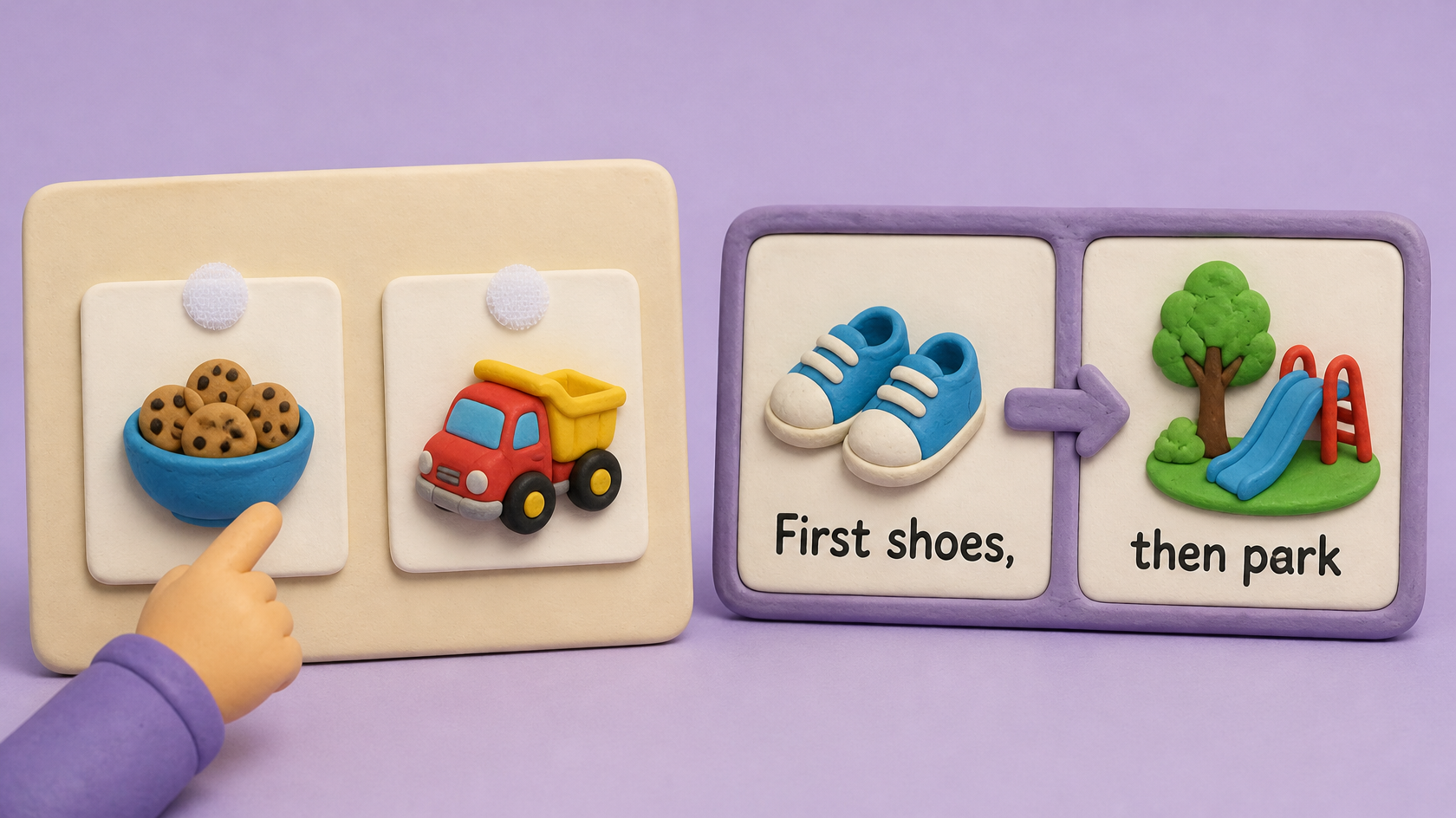
A choice board shows two or three options, so your child can pick one. It works because choosing is easier than coming up with an answer from scratch.
Choose a moment that matters to your child, such as a snack, a toy or an activity.
Take photos of the real items, or print simple pictures. Real photos are often easiest to understand at first.
Stick two options on a piece of card with Velcro or tape.
Hold it up, name the choices out loud, and let your child point, touch or look at the one they want.
Give them that item right away, so they learn that choosing works.
Start with two choices of things your child already loves. You can add more options later.
Use first-then boards for transitions
A first-then board shows one thing to do now and one thing coming next ("First shoes, then park"). It is simple, visual and helps with the moments that are hard to leave, like turning off the TV or getting in the car. Keep the "then" something your child enjoys and always follow through.
Make the whole house communication-friendly
Label key places. Add a picture to the fridge, the bathroom door and the toy bin.
Keep tools in reach. A board that is hidden in a drawer will not be used. Hang a small one in each main room, or keep one on a ring that travels with you.
Model it yourself. Point to the pictures as you talk, the same way you would speak to a child learning words. Children learn to use the tools by seeing you use them.
Wait and watch. After you ask a question or offer a choice, pause for several seconds. Give your child time to respond in any way, and respond warmly when they do.
Accept every attempt. A point, a glance, a sound or a push of a card all count as communication. Respond to it so your child learns that it works.
Common mistakes to avoid
Using too many pictures at once, which can feel overwhelming. Fewer, clearer choices work better.
Using the board only for testing ("What is this?"). Use it to give your child real choices and real control.
Giving up after a few days. New tools take weeks of practice and a lot of repetition.
When to ask for more help
Low-tech tools are a strong foundation, but every child is different. A speech-language pathologist can help you find the right symbols, layout and next steps, including whether a communication device could be a good fit.
Try this today: Take two photos of things your child loves, stick them on a card, and offer the choice at your next snack.
Gentle Compass shares general information and ideas, not medical or clinical advice. For individual support, talk with your child's care team.